
How to Get IELTS Band 7: A 30-Day Study Plan

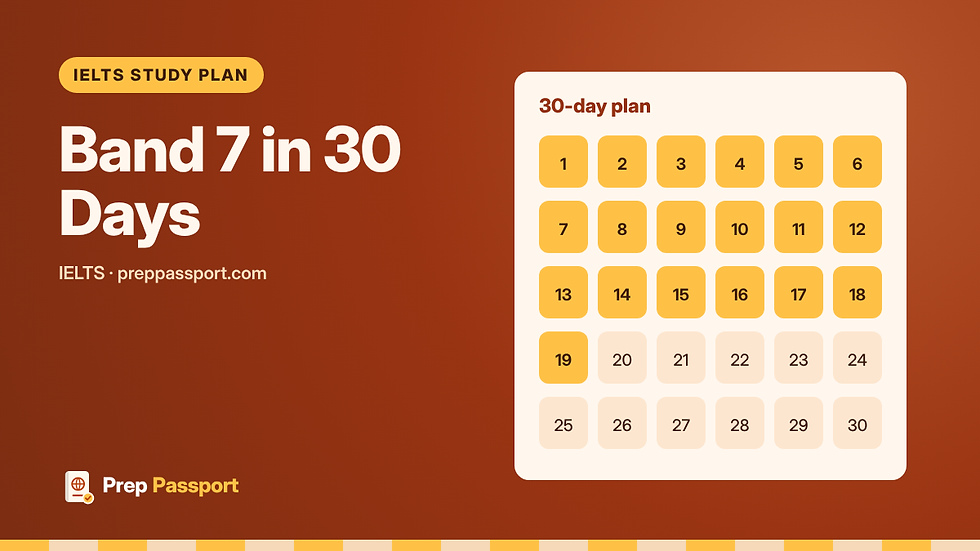
To get IELTS band 7, you need your four skill scores to average 6.75 or higher, because your overall band is rounded to the nearest half band. The fastest way there in 30 days is to find your weakest skill with a timed mock, train it daily, and take a full mock each week. This plan shows you exactly what to do, week by week.
Quick answer: Take a full timed mock on day 1. Spend weeks 1–2 fixing your two weakest skills, week 3 building speed and accuracy under timing, and week 4 on full mocks and review. Study about 2 hours a day. Remember: an average of 6.75 rounds up to 7.0, but 6.625 rounds down to 6.5.
This plan works best if you're already around band 6 to 6.5. If you're further away, use the same structure but give yourself more time.
How IELTS band rounding works (and why it matters for band 7)
Each skill (Listening, Reading, Writing, Speaking) gets a band from 0 to 9 in half bands. Your overall band is the average of the four, rounded to the nearest half band. According to ielts.org's scoring guide:
An average ending in .25 rounds up to the next half band (6.25 → 6.5).
An average ending in .75 rounds up to the next whole band.
Anything else rounds to the nearest half (6.125 → 6.0; 3.875 → 4.0).
Here's what that means for a band 7 target:
Listening | Reading | Writing | Speaking | Average | Overall |
|---|---|---|---|---|---|
7.0 | 7.0 | 6.5 | 6.5 | 6.75 | 7.0 |
7.5 | 7.0 | 6.5 | 6.0 | 6.75 | 7.0 |
7.0 | 7.0 | 7.0 | 6.5 | 6.875 | 7.0 |
7.0 | 6.5 | 6.5 | 6.5 | 6.625 | 6.5 |
7.5 | 7.0 | 6.0 | 6.0 | 6.625 | 6.5 |
The lesson: you don't need 7 in every skill for a 7 overall. But one weak skill can pull you down a half band. Check your own combinations with our IELTS band calculator.
Before you start, also check whether your university or visa needs a minimum in each skill, not just overall. Our score requirements guide can help.
Know the test you're training for
Your practice should match the real format (British Council test format):
Section | Time | What it includes |
|---|---|---|
Listening | 30 min | 4 parts, 40 questions |
Reading | 60 min | 40 questions (Academic: 3 passages; General Training: 5–6 short texts) |
Writing | 60 min | 2 tasks |
Speaking | 11–14 min | 3 parts, face-to-face |
The total is 2 hours 45 minutes. Listening, Reading and Writing happen on the same day with no breaks. Train your stamina for that.
Paper IELTS is ending worldwide from mid-2026, so plan on the computer test (ielts.org delivery update). Practice typing your Writing answers, not just handwriting them.
How to get IELTS band 7: your 30-day plan, week by week
Day 1: Diagnose
Take a full, timed IELTS practice test. Score it honestly. Write down your band for each skill and list the two weakest. Everything else in this plan depends on this step.
Week 1 (days 2–7): Fix the foundations
Study the question types in your two weakest skills.
For Writing, learn the structure of Task 1 and Task 2. Write one task a day.
For Speaking, record yourself answering Part 1 and Part 2 questions every day.
For Listening and Reading, do one section a day and review every wrong answer.
Week 2 (days 8–14): Targeted practice
Keep the daily Writing task. Compare each answer with the official band descriptors.
Build topic vocabulary for common themes (education, environment, technology, work).
Practice Speaking Part 3: give an opinion, a reason and an example.
End the week with one full mock. Compare it with day 1.
Week 3 (days 15–21): Timing and accuracy
Do every Listening and Reading set under strict time.
Write both tasks inside the 60 minutes, using a time split you decide in advance (many students give Task 2 the larger share).
Find your repeat mistakes (spelling, plurals, articles, tense) and fix them one at a time.
Take a second full mock at the end of the week.
Week 4 (days 22–30): Mocks and polish
Take two full mocks this week, under real conditions.
Spend the days in between reviewing, not learning new material.
Days 29–30: light review only. Rest, sleep and prepare your ID.
Daily schedule (about 2 hours)
Time block | Activity | Focus |
|---|---|---|
20 min | Listening or Reading set | Timed, then review mistakes |
40 min | Writing task | One task under time |
15 min | Writing review | Check against descriptors; rewrite one paragraph |
20 min | Speaking | Record, listen back, repeat one answer |
15 min | Vocabulary and grammar | Topic words; fix one repeat error |
10 min | Plan tomorrow | Note your weakest point of the day |
Short on time? Keep the Writing and Speaking blocks.
Skill-by-skill tactics for band 7
Listening
Read the questions before each part starts, and predict the type of answer (a number, a name, a place).
Watch for distractors: speakers often correct themselves.
Check spelling and word limits. A correct idea with a spelling error can still lose the mark.
Reading
Don't read every word first. Skim for structure, then scan for answers.
For True/False/Not Given, ask: "Does the text actually say this?"
Move on from hard questions and return at the end.
Writing
Answer the exact question. Off-topic essays are a common way to lose marks.
Use a clear structure: introduction, two body paragraphs, conclusion.
In Task 1, include an overview of the main trend or feature.
Aim for accuracy first. A range of grammar only helps when it's correct.
Speaking
Extend your answers with reasons and examples.
Don't memorize scripts. Examiners want natural speech.
If you don't understand a question, it's fine to ask the examiner to repeat it.
If you fall just short
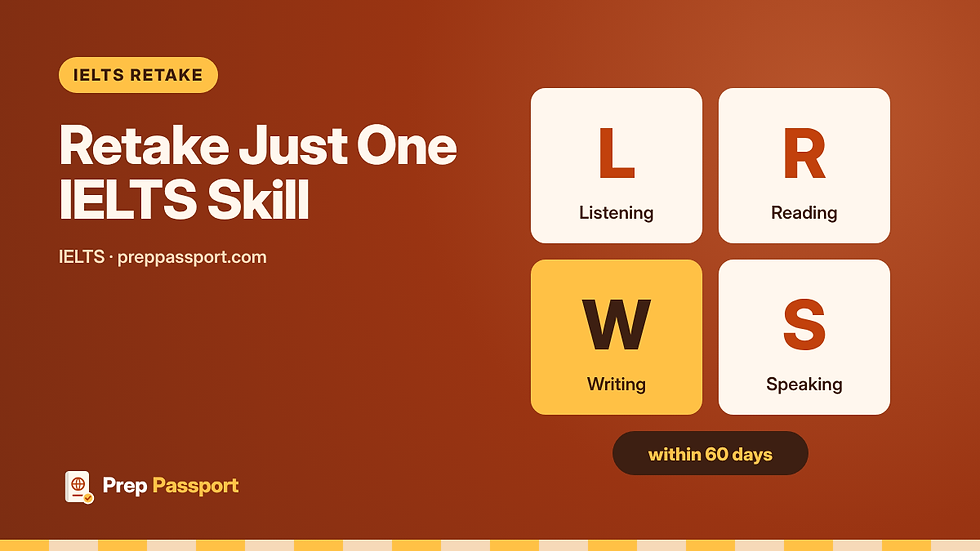
If you miss band 7 because of one skill, you may be able to use IELTS One Skill Retake. It's available for computer-delivered Academic, General Training and UKVI at participating centres. You must book and sit it within 60 days of your original test, and you retake one skill only (British Council One Skill Retake FAQs).
Not all organisations accept One Skill Retake results, so check before you book. Use our score gap tool to see which skill to retake.
Key takeaways
An average of 6.75 rounds up to 7.0; 6.625 rounds down to 6.5.
You don't need 7 in every skill, but one weak skill can cost you a half band.
Start with a full timed mock and train your two weakest skills first.
Practice typing your Writing; plan on the computer test.
Take weekly full mocks and review every mistake.
One Skill Retake can help if one skill holds you back.
FAQ
Can I get IELTS band 7 in 30 days?
It's possible if you're already close, for example around 6 to 6.5. If you're further away, use this plan as a 30-day cycle and repeat it.
What average do I need for an overall 7?
An average of 6.75 or higher. An average of 6.75 rounds up to 7.0.
Which IELTS skill is hardest for band 7?
It's different for everyone. Your day 1 mock tells you which skill is hardest for you.
How many hours a day should I study for IELTS?
About 2 focused hours a day works for this plan. Consistency matters more than long, irregular sessions.
Do I need 7 in every section?
Not for a 7 overall. But your university or visa may set a minimum for each skill, so check.
How soon will I get my IELTS results?
Computer-delivered results usually arrive in 1–2 days (some countries say 1–5 days).
Start your plan today
Day 1 is the most important day. Take a free timed IELTS practice test, get your band for each skill, and build your 30 days from there in the Student Hub.
Checked against official sources on 26 October 2026. Fees and rules change, so confirm on the official site before you book.
IELTS, TOEFL, PTE and Duolingo English Test are trademarks of their owners; Prep Passport is not affiliated with them.

Comments